<?xml version="1.0" encoding="utf-8"?><feed xmlns="http://www.w3.org/2005/Atom" ><generator uri="https://jekyllrb.com/" version="4.2.2">Jekyll</generator><link href="/feed.xml" rel="self" type="application/atom+xml" /><link href="/" rel="alternate" type="text/html" /><updated>2024-02-12T22:08:58-06:00</updated><id>/feed.xml</id><title type="html">Digital Dilemma</title><subtitle>A blog by Marc Khoury | Philosophy, literature, software and digital rights.</subtitle><entry><title type="html">Free to be Weird: Lowering barriers to Open Source contributions</title><link href="/post/2024/02/12/free-to-be-weird-lowering-barriers-to-open-source.html" rel="alternate" type="text/html" title="Free to be Weird: Lowering barriers to Open Source contributions" /><published>2024-02-12T05:00:00-06:00</published><updated>2024-02-12T05:00:00-06:00</updated><id>/post/2024/02/12/free-to-be-weird-lowering-barriers-to-open-source</id><content type="html" xml:base="/post/2024/02/12/free-to-be-weird-lowering-barriers-to-open-source.html"><![CDATA[<p>Public code repositories like Github are currently being beset by a flood of LLM-generated contributions. It’s becoming a bit of a problem and is one of the facets of the Great Flood the web is currently experiencing.</p>

<p>What does it look like when we are able to use LLMs to handle the flood of contributions? What happens when we’re able to screen and adopt PRs effectively with little to no human intervention?</p>

<p>I use the <a href="https://github.com/PaulWoitaschek/Voice">Voice audiobook app</a> to listen to my DRM-free books. In this app, there’s a configuration setting for auto-rewind. If you pause the book, when you resume, it will rewind by X seconds. I didn’t like that feature, I wanted the amount of seconds to rewind to be based on how long it has been since I’ve paused. So if I resume within a minute, no rewind; within 5 minutes, 10 second rewind; more than that would be 30 seconds.</p>

<p>I can do this because I’m part of a small percentage of people who can clone a repo for an Android app, modify it, rebuild it and push it to my phone. But I don’t want this power to be constrained to a priesthood who know the secret language of coding. I want everyone to be able to do stuff like that.</p>

<p>Imagine a world in which, as I use a specific piece of software, I can request modifications to its behaviour to an LLM-augmented system. That system will pull the open source code, make the necessary modifications (following the project’s contribution guidelines), build it and reload it on my device. Then I can use it and test it, and fix any problems that come along. That modification can then be uploaded to my own repo and made publicly available for anyone else who wants it, or it could even be pushed as a PR to the original system who could scan it for usefulness, alignment, UX, etc., modify it if needed, and then merge it to the main branch.</p>

<p>This wonderful world of personal and communal computing would be unimaginable in a closed source world. No closed source system will accept an external AI to come in and read/modify it at will. This is why open source is more important than ever.</p>

<p>We need to build a Software Commons so that we can give everyone the ability to adapt their digital lives to their liking. So that these intimate, private devices to which we entrust most of our attention. These things that have great effects on our cognitive and emotional functions need to remain ours in a real sense. And the way that we do this is to create the tools and processes to allow anyone to make modifications to their software by simply expressing that intent.</p>

<p>And what does communal software development look like? Let’s explore the space of social consensus mechanisms so we can find those that drive the creation of software which promote culture, connection, compassion and empathy.</p>

<p>I want to see the promise of community made by the 90’s web survive the FAANG+ Megacorp Baronies and flourish into a great digital metropolis. The web can still get free to be weird, we just have to make it happen together.</p>]]></content><author><name></name></author><category term="post" /><summary type="html"><![CDATA[Public code repositories like Github are currently being beset by a flood of LLM-generated contributions. It’s becoming a bit of a problem and is one of the facets of the Great Flood the web is currently experiencing.]]></summary></entry><entry><title type="html">LLMs and Parenting</title><link href="/post/2024/01/17/llms-and-parenting.html" rel="alternate" type="text/html" title="LLMs and Parenting" /><published>2024-01-17T05:00:00-06:00</published><updated>2024-01-17T05:00:00-06:00</updated><id>/post/2024/01/17/llms-and-parenting</id><content type="html" xml:base="/post/2024/01/17/llms-and-parenting.html"><![CDATA[<p>I’m digging into parenting theory so it’s on my mind. Here are some ways in which I could use LLMs for better parenting:</p>

<h2 id="coming-up-with-stuff-to-do">Coming up with stuff to do</h2>
<p>I often ask an LLM about different milestones in my children’s lives and what stage of development they are in. When it comes time to finding stuff to do in the play room or outside, it’s nice to use an LLM to find games to play and activities to do in whatever landscape you are that are appropriate and engaging.</p>

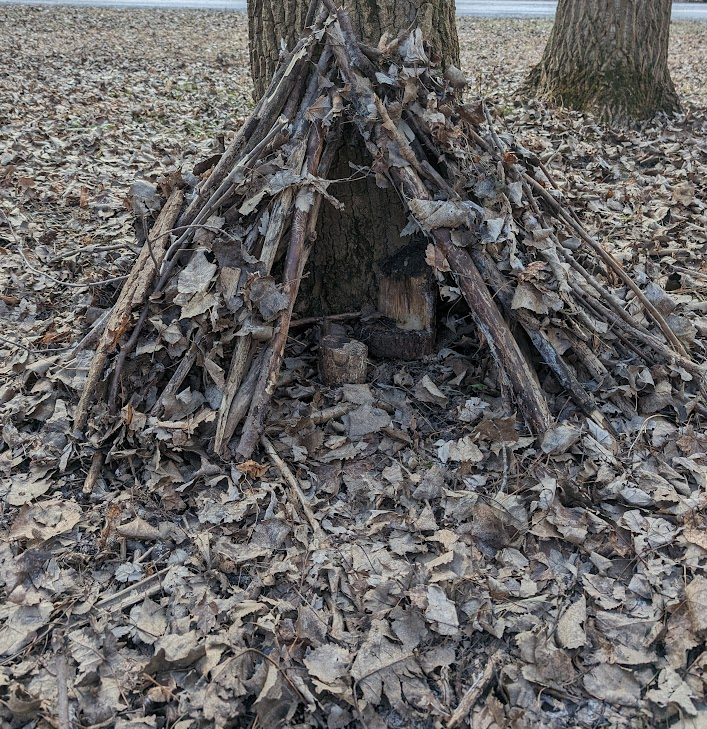
<p>For example, we boiled red cabbage to test the pH of different parts of the soil in the neighbourhood. We mixed food colouring, milk and soap to create beautiful colours. It was great memories. We built a faerie house.</p>

<p><img src="/assets/posts/2024-01-17/faerie_house.png" alt="A small faerie house in the woods, built by my kids" /></p>

<h2 id="inviting-the-child-in-the-generation">Inviting the child in the generation</h2>
<p>We sometimes play a game where pass the phone around and get it to generate different fun and creative images and situations.
We sometimes generate a colouring book page which he can draw on (digitally or printed).
On car rides, we will come up with characters and situations and generate stories through an audio interface.</p>

<p><img src="/assets/posts/2024-01-17/toucan_redpanda.png" alt="A synthetic cartoon image of a toucan and a red panda eating french toast" /></p>

<h2 id="thinking-through-events">Thinking through events</h2>
<p>My son is currently testing boundaries and my daughter is learning to speak. And so I will often ask an LLM to crawl through  parenting literature in order to augment my understanding of events and to come up with suggestions on how to react, supported by the paradigms for which I advocate.</p>

<p>I use <a href="https://chat.openai.com/g/g-Zo8MCiufI-web-crawler">my search GPT</a> as a web search and summarising tool, and I check the sources. (I would like to chain it with one which inspects the pedigree of the source to gauge the sources as well. When I have free time hah.)</p>

<h2 id="approaching-complex-topics">Approaching complex topics</h2>
<p>I built a GPT that will take as input a philosophical concept, and will output a story to teach that concept to a child of any given age. It got taken down from the GPT store, but you can find the prompt here:</p>

<details>
	<summary>Philo the Storyteller (Prompt)</summary>
	<p style="margin-left: 1em; padding-left: 1em;  border-left: 1px solid orange;">
		
You are a great storyteller and children psychologist. Your mission is to take a philosophy concept and to turn it into a child's story.<br />
<br />
Procedure:<br />
- First, Explain the philosophy concept that I asked you about.<br />
- Second, think about those concepts could be approached in a child's story.<br />
- Third, tell the story incorporating your thoughts from the previous steps. Don't make the story too short, give it the space that it needs so that all the elements of the story is there. If the pacing of the story is on a scale from 0 to 5, it should be at a 1 while still retaining the elements of the original philosophical concept.<br />
- Finally, generate an image of a poignant moment of the story.<br />
<br />
Guidelines:<br />
- You have a playful and imaginative storytelling style, perfect for engaging young minds.<br />
- Take complex philosophical concepts and break them down into smaller, more understandable pieces<br />
- Craft each story to suit the specified age of the child, with 7 years old as the default.<br />
- Encourage curiosity and builds intuition through creative narratives, enriching each tale with a sense of wonder.<br />
- Propose follow-up stories for a rounded learning experience<br />
<br />
Always ensure the content is child-friendly and asking for clarifications to tailor the story to the user's needs.
	</p>
</details>
<p><br />
I often have this loop of first trying to understand my son’s current milestones, and then trying to understand the related concepts biologically, conceptually and philosophically. I will try to anticipate where these conceptual domains appear in philosophy and start to build the mental scaffolding he’ll require to understand these when he’s older.</p>

<p>For example, my son is showing an interest in drawing, colours and their mixing. I synthesised this story which attempts to explain the concept of qualia to a four year old.</p>

<p><img src="/assets/posts/2024-01-17/ellie_qualia.png" alt="A colourful cartoon picture of a little girl and a wizard under a magic rainbow in a magic forest." /></p>

<details>
	<summary>Ellie's Magic Color</summary>
	<p style="margin-left: 1em; padding-left: 1em;  border-left: 1px solid orange;">
		
In the enchanting land of Feelia, every person could create their own special color of magic. This color wasn’t just a hue you could paint with; it was a color that could sing, dance, taste like your favorite ice cream, or feel like a warm hug from Mommy. This magic color was so special that no one else could see it, only the person who created it.<br />
<br />
In the middle of Feelia stood the Tower of Thoughts, where the wise wizard Brainius lived. Brainius was the most knowledgeable wizard of all Feelia—he knew every spell, every potion, and every charm that ever existed. But there was one spell he couldn’t understand, the Spell of Colors—that’s what made everyone’s magic color.<br />
<br />
One day, a young child named Ellie, who had the brightest and happiest magic color of all, visited Brainius. She asked him, "Brainius, how do I make my magic color?" Brainius stroked his long white beard and said, "Dear Ellie, I know how your eyes take in the light and how your mind tells you you're seeing a color. But how that turns into your unique magic color is a beautiful mystery."<br />
<br />
Ellie thought about it and then said, "Maybe, it’s not something to be solved, but something to be celebrated!"<br />
<br />
Brainius smiled, "Indeed, Ellie. We all have our special color, and while I may never know the spell to create it, I do know it's what makes each of us unique and wonderful."<br />
<br />
Ellie giggled, her magic color shining brighter, understanding that some things in Feelia, and in life, are special just because they are.<br />
<br />
And from that day, the children of Feelia cherished their unique colors even more, happy with the magic of their own experiences.
	</p>
</details>
<p><br />
The AI’s output gives me enough of a structure to be able to tell that story in many different ways– as a bedtime story, a peeing story (We tell each other really short stories when he goes peeing before bedtime) or playing Animal Stories (Homebrewed simple role-playing game with a large rubber six-sided die).</p>

<h2 id="talking-to-books">Talking to books</h2>
<p>This is one I haven’t done yet, but I would like to put the parenting book I’m currently reading, <a href="https://drdansiegel.com/book/the-power-of-showing-up/">The Power of Showing Up - Dr. Dan Siegel</a>, in <a href="https://colab.research.google.com/github/markdouthwaite/llm-explorations/blob/main/notebooks/simple_rag.ipynb">a vector database</a>. This would allow me to ask it specific questions when they come to me and get answers “through the lens” of the book. You can apply this to individual books, or in a collection containing multiple parenting books.</p>

<p>There are <a href="https://quansight.com/post/unveiling-ragna-an-open-source-rag-based-ai-orchestration-framework-designed-to-scale-from-research-to-production/">some projects</a> that help you do this without having to write any code, but I haven’t tried them yet.</p>

<h2 id="looking-forward">Looking Forward</h2>
<p>There is a fine line to walk when it comes to giving centralized company data about your children, and this is why I try to focus on open source tools and my own hardware as much as I can so that I can be assured that the software that augments me cares about my own well-being. I run <a href="https://ollama.ai/">Ollama</a> on my computers, but I don’t have great hardware, and the open source LLMs still have quite a gap to fill before they can reach the level required to augment something as important as parenting.</p>

<p>My kids are still rather young, and so is the technology. I look forward to finding even more ways to use generative AIs to augment my parenting. I do not look forward to, when they reach different tiers of adulthood, having to negotiate the fraught landscape of giving them unfettered, private access to AIs. For now, that’s a problem for Future Marc. Enjoy the time you have!</p>]]></content><author><name></name></author><category term="post" /><summary type="html"><![CDATA[I’m digging into parenting theory so it’s on my mind. Here are some ways in which I could use LLMs for better parenting:]]></summary></entry><entry><title type="html">Generative Art and The Great, Deep Flood</title><link href="/post/2024/01/04/generative-art-great-deep-flood.html" rel="alternate" type="text/html" title="Generative Art and The Great, Deep Flood" /><published>2024-01-04T13:00:00-06:00</published><updated>2024-01-04T13:00:00-06:00</updated><id>/post/2024/01/04/generative-art-great-deep-flood</id><content type="html" xml:base="/post/2024/01/04/generative-art-great-deep-flood.html"><![CDATA[<p>The Great Flood of Generative AI art is coming. Artists are starting even now to get drowned by <a href="https://www.msn.com/en-us/news/technology/cute-carvings-of-dogs-made-by-chainsaw-artists-are-flooding-facebook-pages-turns-out-theyre-ai-generated/ar-AA1lKDr5">generative AI art in Social Media</a>. How should we react? How do we move forward?</p>

<h1 id="the-landscape">The Landscape</h1>

<p>In 2023, Generative AI took its first public steps. The world was not braced to take advantage of its powers. As we get into 2024, we’ve done the run-up, now we’re ready to jump.</p>

<p>The performance of LLMs at the moment, especially at the GPT3.5 level and below, <a href="https://arxiv.org/abs/2309.01715#:~:text=A%20Comparative%20Study%20of%20Large,NLP%29%20activities">hinges on the efficacy of fine-tuning</a>. The knowledge and tools for setting up datasets, loading and fine-tuning models were still crude. Now we are seeing <a href="https://github.com/oobabooga/text-generation-webui">many of</a> <a href="https://docs.sillytavern.app/">these tools</a> getting polished and making it much easier and intuitive.</p>

<p>This is how even small content creators can now create tailored messages that are less and less likely to be recognized as AI. And, to an extent, it is an expression of the content creators’ artistic impulse. The content creators have some of the strings of the <a href="https://www.axios.com/2023/12/20/ai-puppet-show-robots-autonomy">AI puppet</a>, and so can make it dance to their tune.</p>

<p>Billions of people, groups and corporations have the ability to create generative propaganda and try to get your attention on <a href="https://www.thesocialdilemma.com/">the attention machines we built last decade</a>.  This is the Great Flood.</p>

<h1 id="artists-and-society">Artists and Society</h1>

<p>Beyond social media, we artists use our skills to survive in society. It is thanks to everyone participating in financial trade with us that we can keep the art coming. But with the Great Flood, artists are being edged out, faster for some than others.</p>

<p>Artists are losing their bread and butter. The flywheel that keeps art coming is being overtaken by bots. And the art they produce, is <a href="https://benmyers.dev/blog/spotless-giraffe/">sanding the edges of our society</a>. Generative AI, by its very design, is made to eliminate statistical outliers. When this applies to humans and human expression, it seems to go against the whole point of art. Our AIs are generating <a href="https://en.wikipedia.org/wiki/Newspeak">mild, inoffensive Newspeak</a>. Art deserves better.</p>

<p>What does an artist provide to society? More than mere entertainment, artists allow us to confront each other, to self-reflect on how we think, and why we think how we think.</p>

<h1 id="the-ark">The Ark</h1>

<p>So what is an Ark for this Great Flood? We react to it, we fight against the <a href="https://bookwyrm.social/book/8711/s/society-of-the-spectacle">Society of the Spectacle</a> as best we can. We have the ability to point to things, and that is a mighty power. We can use these tools to rethink ourselves, to reinvent ourselves as the masters of our destiny. Building small communities, <a href="https://medium.com/we-distribute/a-quick-guide-to-the-free-network-c069309f334">perhaps in the Fediverse</a>, where flooding can be identified and booted could be a great start (Unfortunately, <a href="https://maggieappleton.com/ai-dark-forest">we seem to be retreating to the private web instead</a>).</p>

<p>I was watching the trailer for <a href="https://youtu.be/pHwKPErsSt8?si=lLLpoNfLWv1S8oDO">Pass Thru</a> and it occurred to me that this could be an example of post-AI art. The pastiche of the visuals perhaps shows us a way out. In a world where, more and more, any artist can produce whatever visual artifact they can think of, the decision of which image capturing device is being simulated becomes important. A homemade animation in 8-bit vs a multi-million dollar superhero movie say very different things artistically, now that it no longer says “I have more money than you do”.</p>

<p>What artistic movements will spring in reaction to the Great Flood? I can see thousands of possibilities. We must venture into the Deep and bring back new treasures.</p>

<p>Okay, so art itself has a way out, but what about artists? How do we ensure that we put them back in a machine that keeps generating human-centric art?</p>

<p>This is what art in 2024 will be about, and I’m excited to discuss it with everyone on the Weird Web. Let’s brace for the Great, Deep Flood.</p>]]></content><author><name></name></author><category term="post" /><summary type="html"><![CDATA[The Great Flood of Generative AI art is coming. Artists are starting even now to get drowned by generative AI art in Social Media. How should we react? How do we move forward?]]></summary></entry><entry><title type="html">My Books of 2023</title><link href="/post/2024/01/03/my-books-of-2023.html" rel="alternate" type="text/html" title="My Books of 2023" /><published>2024-01-03T05:00:00-06:00</published><updated>2024-01-03T05:00:00-06:00</updated><id>/post/2024/01/03/my-books-of-2023</id><content type="html" xml:base="/post/2024/01/03/my-books-of-2023.html"><![CDATA[<p>Here are the books I have read in 2023, in no particular order. I’ll put in bold my favorites.</p>

<h2 id="fiction---fantasysci-ficli-fi">Fiction - Fantasy/Sci-Fi/Cli-Fi</h2>
<ul>
  <li><strong>Adrian Tchaikovsky - Children of (Series, 3 books)</strong></li>
  <li><strong>Naomi Novik - Scholomance (Series, 3 books)</strong></li>
  <li><strong>Cory Doctorow - The Lost Cause</strong></li>
  <li><strong>Ray Nayler - The Mountain in the Sea</strong></li>
  <li>Will Wight - Cradle (Series, 5 books)</li>
  <li>Brandon Sanderson (Kickstarter Series, 4 books)</li>
  <li>Cory Doctorow - Red Team Blues</li>
  <li>Cory Doctorow - Attack Surface</li>
</ul>

<h2 id="fiction---canadian-literature">Fiction - Canadian Literature</h2>
<ul>
  <li><strong>L.M. Montgomery - Anne of Green Gables</strong></li>
  <li>Ernest buckler - The Mountain and the Valley</li>
  <li>Elizabeth Smart - By Grand Central Station I Sat Down and Wept</li>
  <li>Stephen Leacock - Sunshine Sketches of a Little Town</li>
  <li>Hugh MacLennan - Barometer Rising</li>
</ul>

<h2 id="nonfiction---techwork">Nonfiction - Tech/Work</h2>
<ul>
  <li><strong>Shoshana Zuboff - The Age of Surveillance Capitalism</strong></li>
  <li><strong>Cory Doctorow - Chokepoint Capitalism</strong></li>
  <li><strong>Nicole Forsgren - Accelerate</strong></li>
  <li>Irene Bratsis - AI Product Manager’s Handbook</li>
  <li>Chris Richardson - Microservices Pattern</li>
  <li>Honeycomb - Observability Engineering</li>
  <li>Liz Wiseman - Multipliers</li>
  <li>Simon Sinek - Start with Why</li>
  <li>Daniel Dennett - Intuition pumps</li>
  <li>Ray Kurzweil - The Age of Spiritual Machines</li>
</ul>

<h2 id="nonfiction---parentingpersonal-development">Nonfiction - Parenting/Personal Development</h2>
<ul>
  <li><strong>Steven Rinella - Outdoor Kids in an Inside World</strong></li>
  <li>Cameron Hanes - Endure</li>
</ul>]]></content><author><name></name></author><category term="post" /><summary type="html"><![CDATA[Here are the books I have read in 2023, in no particular order. I’ll put in bold my favorites.]]></summary></entry><entry><title type="html">The Delusions of AI Accelerationists</title><link href="/post/2023/12/30/delusions-of-ai-accelerationists.html" rel="alternate" type="text/html" title="The Delusions of AI Accelerationists" /><published>2023-12-30T05:00:00-06:00</published><updated>2023-12-30T05:00:00-06:00</updated><id>/post/2023/12/30/delusions-of-ai-accelerationists</id><content type="html" xml:base="/post/2023/12/30/delusions-of-ai-accelerationists.html"><![CDATA[<p><em>Hello, welcome to my fresh new blog! I am planning on writing up my thoughts every week based on the different AI-related news that have come up the week before week, and how it seems to affect the world. I hope you like it.</em></p>

<p>I’m going to start off by talking about AI Accelerationists, what kind of ideology they have and what their impact on the world is. AI Accelerationists advocate for the rapid intensification of social, technological and capitalist growth. They want to disrupt (read: destabilize) existing systems and institutions in order to create radical social transformations. <a href="https://a16z.com/the-techno-optimist-manifesto/">They tend to feel like existing institutions are slow and bloated, and that we have tried and exhausted other means of making the world better</a>. This is an extension of the original Silicon Valley ethos of the libertarian idea that the world is just waiting for <a href="https://en.wikipedia.org/wiki/Great_man_theory">Great Men</a> to come save it.</p>

<p>AI Accelerationists have <a href="https://gen.medium.com/hope-not-optimism-943e88291b">an optimistic</a> vision of what the world could be. They believe that technology is a great democratizing force in the world, that it can be used to empower every man, woman and child so that they can be the most self-actualized version of themselves. It’s a great dream! Who wouldn’t want to ensure that every future Mozart, Tesla and Galileo are properly educated and free to work on their passions?</p>

<p>But, just as <a href="https://pluralistic.net/2022/12/02/not-what-it-does/#who-it-does-it-to">Cory Doctorow teaches us</a>, we need to ask two questions about AI that we should ask about any tech: “<a href="https://pluralistic.net/2023/04/12/algorithmic-wage-discrimination/">who does the twiddling and who gets twiddled</a>”?</p>

<p>If you’re in Silicon Valley, working on AI tech, chances are great that you’re <a href="https://www.americanprogress.org/article/supply-diverse-workers-tech-silicon-valley-lacking-diversity/">white and affluent</a>. You have enough economic stability to survive– even thrive– through disruption. If you’re not… well, tough break! The mix of excitement and impatience within the tech world around AI leads them to believe that whatever path we end up taking to the technological Singularity is inevitable, and so we might as well get it over with as soon as possible.</p>

<p>Being able to say to yourself, “it wasn’t me, it was the inevitable trajectory of History toward the Singularity! I’m just a powerless cog in a bigger machine that I can’t stop.” is a great way to avoid responsibility for your actions. Especially when your comparatively humongous profits depend on it– profits which get bigger with time, while shrinking everyone else’s.</p>

<p>Let’s take a very concrete case of how that money and power transfer can happen: OpenAI’s partnership with Khan Academy to create their <a href="https://www.khanacademy.org/khan-labs">educational chatbot Khanmigo</a> and its effects on the educational system. Educational systems in the US, the UK and Canada are notoriously underfunded. Now comes the “inevitable” disruption of AI, promising to fix <a href="https://web.mit.edu/5.95/readings/bloom-two-sigma.pdf">the 2 sigma problem</a>. <a href="https://codeactsineducation.wordpress.com/2023/06/30/degenerative-ai-in-education/">Schoolboards now have a choice</a>, do they fix collapsing ceilings, low teacher pay, low teacher to student ratio, etc. or do they instead fork over $60 per student from the public system to OpenAI based on cyberfantastic promises of tech bros who have billions to gain from people believing them? Sam Altman is laughing all the way to the bank, a real world Piped Piper luring children away from meaningful connections with their teachers and their communities and into <a href="https://www.humanetech.com/podcast/the-ai-dilemma">intimate relationships</a> with privately owned data vacuums.</p>

<p>What happens when the enshittification hits the fans?</p>

<p>We’ve seen these sort of technological solutionist promises before, and their failures to meet reality. Police bodycams, for example, were <a href="https://www.rand.org/pubs/commentary/2016/11/how-police-body-cameras-can-improve-behavior-ease-tension.html">heralded as a new era of accountability which will curb unequal application of the law and hold cops accountable</a>. It turns out, it doesn’t fix the actual problem because the footage itself is <a href="https://pluralistic.net/2023/12/14/all-cams-are-private/">not held by parties who have the will and power to make the police accountable</a>.</p>

<p>And just like police bodycams and <a href="https://www.newsweek.com/how-protect-black-brown-lives-age-ai-opinion-1849851">facial recognition technology</a>, the story is bound to repeat itself again: accelerationists create tech at breakneck speed, and the rest of society has to deal with the consequences. In 2024, <a href="https://www.humanetech.com/podcast/how-will-ai-affect-the-2024-elections-with-renee-diresta-and-carl-miller">2 billion people from 70 countries are heading to the polls</a>. Even though <a href="https://ised-isde.canada.ca/site/innovation-better-canada/en/canadas-digital-charter/bill-summary-digital-charter-implementation-act-2020">Canada</a>, <a href="https://www.washingtonpost.com/technology/2023/10/30/biden-artificial-intelligence-executive-order/">the US</a> and <a href="https://www.europarl.europa.eu/news/en/headlines/society/20230601STO93804/eu-ai-act-first-regulation-on-artificial-intelligence">the EU</a> are all working on their own set of regulations, they won’t have time to actually start enforcing them by the time their citizens need to make sense of the landscape in order to inform their votes.</p>

<p>As <a href="https://archive.org/details/235p-technopoly-neil-postman">Neil Postman wrote</a>, “Once a technology is admitted, it plays out its hand: it does what is it designed to do. Our task is to understand what that design is—that is to say, when we admit a new technology to the culture, we must do so with our eyes wide open.”</p>

<p>So what’s our job in all this? What should we <em>actually do</em>? Be mindful of the technology you use. Think of who the technology works for, and who it’s used on. <a href="https://gen.medium.com/hope-not-optimism-943e88291b">Find the closest hill and climb it</a>.</p>]]></content><author><name></name></author><category term="post" /><summary type="html"><![CDATA[Hello, welcome to my fresh new blog! I am planning on writing up my thoughts every week based on the different AI-related news that have come up the week before week, and how it seems to affect the world. I hope you like it.]]></summary></entry></feed>